
I made this lemon mousse for the first time on a rainy Saturday when my kids were bouncing off the walls and I needed something to keep my hands busy. My first attempt came out a little eggy-tasting because I rushed the custard off the heat too early — I learned that patience really is the whole recipe here. Once I got the timing right, the payoff was worth it: a silky, pale-yellow custard folded into clouds of whipped cream, with that fresh, sharp lemon smell hitting you the second you open the fridge.
This is not a “dump everything in a blender” mousse. It’s a proper cooked custard, the kind of technique classic French desserts are built on, lightened at the end with whipped egg whites and whipped cream. That two-step folding is what gives it that soft, airy texture instead of a dense, heavy pudding. My kids call it “lemon cloud” and ask for extra lemon curd on top every single time.
It takes a bit of babysitting on the stove and some patience in the fridge, but there’s no baking and no ingredient you can’t find at a regular grocery store. If you’ve made lemon curd before, you already have the skills for this.
Quick Tip: Read through the whole recipe before you start. You’ll be working with a double boiler and folding technique that both go faster than you’d expect, so it helps to have your whipped cream and egg whites ready to go before the custard comes off the heat.

Lemon Mousse (Creamy 6-Ingredient Recipe)
Description
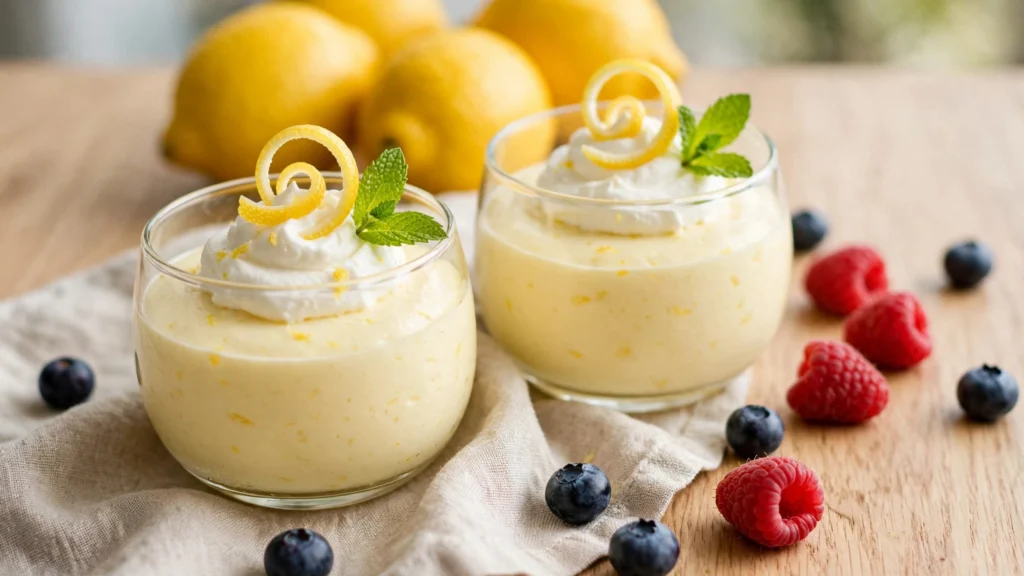
I never thought a six-ingredient dessert could taste this fancy. This lemon mousse starts as a simple stovetop lemon custard, then gets folded not stirred with whipped egg whites and cream until it turns fluffy and light. It's tangy, a little sweet, and finishes cool and smooth on the tongue. Great for a dinner party or just a Tuesday when you want something that feels special.
Ingredients
Ingredients for Six Small Dessert Glasses
For Garnish (choose any)
Instructions
-
In a large heatproof bowl, whisk together 3 whole eggs, the 3 reserved egg yolks (keep the 3 whites in a separate bowl — you'll need them soon), 200g (1 cup) of the sugar, lemon zest, lemon juice, salt, and the vanilla extract if using.
-
Fill a saucepan with a couple of inches of water and bring it to a boil, then reduce to a gentle simmer. Set the bowl over the pan, making sure the bottom doesn't touch the water.
-
Cook, stirring constantly with a wooden spoon or spatula, until the mixture thickens, coats the back of the spoon, and reaches 71°C (160°F) on an instant-read thermometer — usually around 12–15 minutes, but let the temperature be your guide rather than the clock, since stove strength and bowl size change the timing. Don't walk away from the pot or the eggs will scramble instead of turning silky — I learned this the hard way the first time I got distracted refereeing my kids.
-
Remove the bowl from heat. Pour the custard into a shallow dish so it cools faster, and let it sit for 15 minutes, then cover with plastic wrap pressed directly onto the surface and refrigerate for at least 2 hours, until completely cold. Tip: wait until the last 10–15 minutes of this refrigeration time before making the Swiss meringue in Step 5. Whipped egg whites lose volume the longer they sit, so making them too early means a flatter mousse.
-
Prepare the egg whites using a food-safety method — choose one:
- Swiss-meringue method (recommended, no pasteurized eggs needed): Combine the 3 reserved egg whites and the remaining 25g (2 Tbsp) sugar in a heatproof bowl. Set over the same simmering water and whisk gently but constantly until the mixture reaches 71°C (160°F) — the sugar should also be dissolved by this point, which is a useful sign you're close, but temperature is what confirms it's ready. This takes about 4–5 minutes. Remove from heat and beat on high speed until stiff, glossy peaks form, about 3–5 minutes more.
- Pasteurized egg whites method: Use about 100g (⅓ cup + 1 Tbsp) pasteurized liquid egg whites — roughly the equivalent of 3 large egg whites, though it's worth checking your carton's label since concentration can vary slightly by brand. Beat with the 25g (2 Tbsp) sugar on high speed until stiff, glossy peaks form, about 3–5 minutes. No heating step needed.
Either method is the recommended food-safety approach here — whipping raw, unpasteurized egg whites straight from the shell and folding them in uncooked carries a real (if small) Salmonella risk.
-
Once the custard is completely cold, fold the whipped whites in gently — cut down through the center with a spatula, scoop from the bottom, and turn the bowl a quarter turn as you go. Work slowly so you don't knock the air out.
-
In a clean bowl, whip the cold heavy cream on high speed until stiff peaks form, about 3–4 minutes. Don't overwhip, or it will turn grainy and buttery instead of light and smooth.
-
Fold the whipped cream into the lemon mixture the same gentle way. If you want a stronger lemon flavor and a richer lemon finish, fold in the optional lemon curd here too.
-
Spoon the mousse into six small dessert glasses (or one large bowl) and chill for at least 30 minutes before serving. Garnish with your choice of fresh lemon zest, a thin lemon twist, a mint sprig, a dollop of sweetened whipped cream, and/or a few fresh berries.
Nutrition Facts
Servings 6
- Amount Per Serving
- Calories 290kcal
- % Daily Value *
- Total Fat 12g19%
- Saturated Fat 6g30%
- Cholesterol 213mg71%
- Sodium 125mg6%
- Total Carbohydrate 40g14%
- Dietary Fiber 0.8g4%
- Sugars 39g
- Protein 7g15%
- Vitamin C 9 mg
* Percent Daily Values are based on a 2,000 calorie diet. Your daily value may be higher or lower depending on your calorie needs.
Note
- Adding the optional lemon curd deepens the lemon flavor and adds roughly 40–50 extra calories per serving.
- Store in the fridge, covered tightly, at 4°C/40°F or below, for up to 3–4 days. Because this dessert contains egg whites, don't push storage time further even if it looks fine.
- This mousse doesn't freeze well — the texture turns grainy once thawed, so make it fresh instead.
- It's served chilled, so there's no reheating step. If you're warming leftover lemon curd as a topping, a quick 5–10 seconds in the microwave is gentler than the stove and won't split it.
- The finished mousse should hold a soft peak and spoon out cleanly, not pour like a liquid custard. If it's still runny after the final chill, it likely needs more time in the fridge.
- On timing: the three time fields above add up to 3 hours 40 minutes. Real elapsed time is usually closer to 3 hours 30 minutes, since the Swiss-meringue work happens during the last part of the custard's refrigeration rather than adding extra time on top of it.