
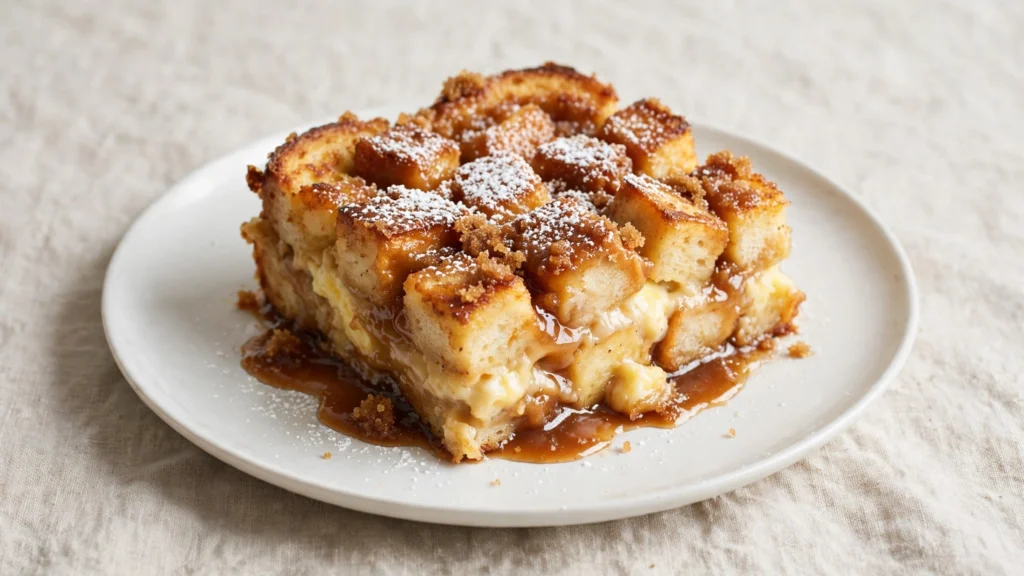

This baked French toast casserole turns the classic breakfast into an easy, make-ahead dish that feeds a crowd without any stovetop flipping. Cubed brioche or challah is layered over a buttery brown sugar base, soaked in a rich cinnamon-vanilla custard, and baked until the top is golden and slightly crisp while the inside stays soft and custardy. The result is a dessert-like breakfast that tastes like sticky, toffee-glazed bread pudding, with just enough structure to hold together on a fork.
What’s Actually Happening in This Recipe
There are two layers doing two different jobs. The bottom layer — melted butter and brown sugar poured into the pan before the bread goes in — browns and becomes sticky and toffee-like as it bakes, forming a coating on the underside of the casserole instead of a plain, dry bottom. The top layer is the bread itself, soaked in a custard of eggs, milk, vanilla, and cinnamon. As it bakes, the custard sets around the bread cubes the way it would in a bread pudding, while the very top, which gets less coverage from the liquid, dries out slightly and turns golden and a little crisp. That contrast — soft, custardy interior against a sticky, toffee-like bottom and a lightly crisp top — is what makes this dish different from simply baking egg-soaked bread.
Why the Ingredient Ratios Matter
The custard-to-bread ratio here (400g eggs plus 600ml milk for a 450g loaf) is deliberately generous — enough liquid that every cube of bread gets fully saturated, since dry pockets of bread won’t soften properly during baking. The brown sugar base itself uses 57g (4 tablespoons) of butter to 100g (½ cup) of brown sugar — roughly a 1:1.75 ratio by weight — which is enough sugar to combine with the melted butter into a smooth, syrupy mixture rather than a grainy one. (The remaining 28g butter and 50g brown sugar are added on top of the soaked bread before baking, not part of the base layer itself.)
Best Bread to Use
Brioche or challah gives the richest flavor because of their higher egg and butter content, and holds up better structurally than plain white bread. Day-old bread works better than fresh, since slightly dried bread absorbs the custard instead of turning mushy. If your loaf is fresh, cube it and leave it uncovered at room temperature for a few hours, or dry it in a low oven for about 10 minutes before using.
Make-Ahead and Occasions
This casserole is well suited to holiday mornings or brunches, since the entire dish can be assembled the night before, refrigerated, and baked fresh in the morning. That makes it a practical option when you want a hot, homemade breakfast without early-morning prep.
Serving Suggestions
Serve warm, straight from the dish, with maple syrup and a dusting of powdered sugar. Fresh berries or a dollop of whipped cream round it out nicely for a brunch spread, and it pairs well with crisp bacon or breakfast sausage on the side for a heartier meal.
Baked French Toast Casserole with Brown Sugar Topping
Description
A rich, custardy baked French toast made with buttery brioche or challah and a browned, sticky brown sugar base. Assemble it the night before and bake it fresh in the morning for an easy, crowd-pleasing brunch centerpiece.
Ingredients
Instructions
-
Heat the oven. Preheat to 350°F (177°C). Lightly butter a 9x13-inch (23x33 cm) baking dish.
-
Make the brown sugar base. Melt 4 tablespoons (57g) of the butter in a small saucepan over medium heat. Stir in ½ cup (100g) of the brown sugar until it combines into a smooth, syrupy mixture, about 1–2 minutes. Pour into the bottom of the dish.
-
Add the bread. Spread the bread cubes evenly over the brown sugar layer.
-
Whisk the custard. In a large bowl, whisk the eggs, milk, vanilla, cinnamon, and salt together until smooth.
-
Pour and soak. Pour the custard over the bread, pressing gently so every piece gets coated. Drizzle with the remaining butter and sprinkle with the remaining brown sugar. Let it sit for 10–15 minutes so the bread can soak up the custard (or cover and refrigerate overnight, baking within 24 hours, if making ahead).
-
Bake. Bake for 30–35 minutes. The top should be golden brown and the center still slightly jiggly, but the definitive test is temperature: insert an instant-read food thermometer into the center of the casserole and bake until it reads 160°F (71°C). This dish contains 8 eggs, and 160°F (71°C) is the USDA-recommended minimum internal temperature for egg casseroles, so don't rely on visual cues alone.
-
Rest, then serve. Let it sit for 10 minutes before slicing — this lets the custard finish setting. Dust with powdered sugar if using, and serve warm with maple syrup.
Nutrition Facts
Servings 8
- Amount Per Serving
- Calories 465kcal
- % Daily Value *
- Total Fat 23g36%
- Saturated Fat 11g56%
- Cholesterol 239mg80%
- Sodium 439mg19%
- Potassium 263mg8%
- Total Carbohydrate 51g17%
- Sugars 28g
- Protein 14g29%
- Calcium 183 mg
- Iron 3.4 mg
* Percent Daily Values are based on a 2,000 calorie diet. Your daily value may be higher or lower depending on your calorie needs.
Note
If baking straight from the fridge, treat 5–10 extra minutes as a starting estimate, not a fixed cutoff — refrigerator temperature, bread density, and dish material all affect how long it takes to heat through. Keep baking, checking every 5 minutes past the estimate, until a food thermometer reads 160°F (71°C) at the center.
Storage: Cover and refrigerate leftovers for up to 4 days.
Freezing: Freeze the baked and cooled casserole, tightly wrapped, for up to 2 months for best quality. Thaw overnight in the refrigerator before reheating.
Reheating: Reheat individual portions in the microwave, or cover the dish with foil and warm in a 325°F (163°C) oven for about 15 minutes.
Pro Tips:
- Use bread that is a day or two old, or dry it briefly in the oven — fresh, soft bread will turn mushy.
- Don't skip the rest time after baking; it keeps slices from falling apart.
- For a firmer, less custardy texture, refrigerate the assembled (unbaked) casserole overnight before baking.
- Use an instant-read food thermometer to confirm the center reaches 160°F (71°C) — this is the reliable way to know the egg mixture is fully cooked, especially important since this recipe contains 8 eggs and is often baked straight from a cold refrigerator.
Common Mistakes:
- Using very fresh, soft bread, which absorbs too much liquid and becomes soggy.
- Skipping the brown sugar base, which is what gives the bottom layer its signature flavor and texture.
- Overbaking, which dries out the edges before the center fully sets.