
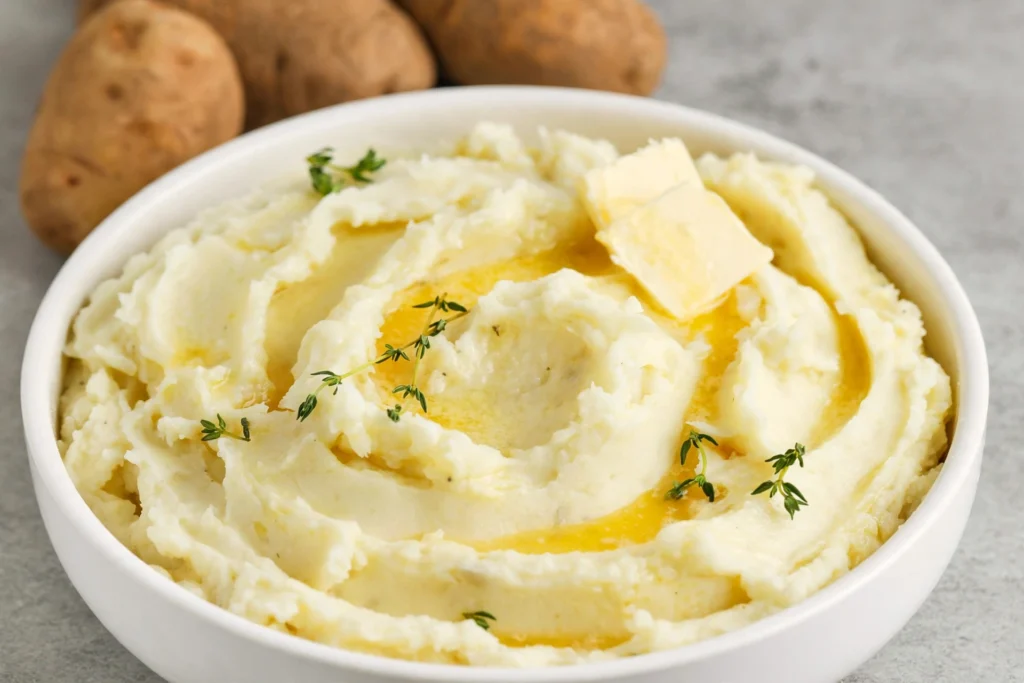

Mashed potatoes don’t need much to be great: good potatoes, real butter, warm milk, and a bit of patience while mashing. This version keeps the ingredient list short on purpose, so the potato flavor stays front and center instead of getting buried under add-ins. The result is soft and fluffy rather than dense or sticky, with just enough body to hold a ladle of gravy without turning to soup.
Why This Recipe Works
- Starchy potatoes — Russet or Yukon Gold — break down smoothly when mashed instead of turning gummy.
- Warming the milk before adding it keeps the potatoes hot and helps the liquid blend in evenly, rather than cooling everything down.
- Mashing by hand with a masher or ricer, instead of a stand mixer, keeps the starch from overworking, which is usually what makes mashed potatoes turn gluey in the first place.
Choosing Your Potatoes
Russet potatoes are the classic choice for the fluffiest texture, thanks to their higher starch content. Yukon Golds are a close second — a little creamier, a little less starchy, with a naturally buttery flavor. Either works well in this recipe, so pick whichever you have on hand or prefer.
Serving and Storage
Serve these hot, straight after mashing, next to roasted meats, gravy, or as part of a bigger holiday spread. They also reheat reasonably well, which makes them a practical dish to get a head start on before a busy meal. Leftovers keep in the fridge for a few days, and they freeze fine too — just add a splash of milk when reheating to bring back the creamy texture.
This recipe uses basic pantry ingredients and simple tools, so it’s a good one to start with if you’re new to mashing potatoes from scratch, but it still holds its own on a holiday table.
Classic Creamy Mashed Potatoes
Description
Fluffy, buttery mashed potatoes made with five simple ingredients, plus optional garlic. Potatoes are boiled until tender, then mashed with melted butter and warm milk into a smooth, creamy side dish that goes with almost any main course.
Ingredients
Instructions
-
Cut the potatoes. Peel the potatoes and cut into roughly equal 5 cm (2-inch) chunks — this helps them all finish cooking at the same time.
-
Start the boil. Put the potatoes and garlic (if using) in a large pot. Cover with cold water by about 2.5 cm (1 inch) and stir in half the salt (about 3 g / ½ tsp). Starting with cold water helps the potatoes cook evenly all the way through.
-
Cook until tender. Bring the water to a full boil (100°C/212°F), then lower the heat until it settles into a steady simmer — small, gentle bubbles rather than a vigorous boil, roughly 85–96°C/185–205°F. Cook uncovered for 15–18 minutes. To check doneness, poke a chunk with a fork — it should slide in with no resistance and the potato should fall apart easily.
-
Drain and dry. Drain well in a colander, then return the potatoes to the empty, still-warm pot for 2–3 minutes off the heat. This lets extra steam escape so the mash doesn't turn watery.
-
Warm the milk. While the potatoes drain, gently heat the milk in a small saucepan or the microwave until steaming (around 65°C/150°F) — don't let it boil. Cold milk will cool down the mash and make it harder to get smooth.
-
Mash. Add the melted butter to the potatoes and mash with a potato masher or ricer until mostly smooth. Pour in the warm milk a little at a time, mashing as you go, until you reach the consistency you like.
-
Season and serve. Stir in the remaining salt (about 3 g / ½ tsp) and the pepper, tasting as you go. Serve right away, while hot.
Nutrition Facts
Servings 8
- Amount Per Serving
- Calories 263kcal
- % Daily Value *
- Total Fat 10g16%
- Saturated Fat 6g30%
- Sodium 318mg14%
- Potassium 977mg28%
- Total Carbohydrate 40g14%
- Dietary Fiber 5g20%
- Sugars 3g
- Protein 5g10%
* Percent Daily Values are based on a 2,000 calorie diet. Your daily value may be higher or lower depending on your calorie needs.
Note
Storage: Refrigerate leftovers promptly — within 2 hours of cooking — in an airtight container, and use within 4 days. Spreading the potatoes into a shallow container before refrigerating helps them cool quickly and safely, rather than sitting out longer at room temperature in a deep pot.
Freezing: These freeze well for up to 2 months. Portion into freezer-safe bags or containers and refrigerate or freeze promptly — within 2 hours of cooking, per standard food-safety guidance. There's no need to wait for the potatoes to reach room temperature first; getting them cold quickly is what matters, not hitting a specific temperature milestone. Press flat to remove air before freezing. Thaw overnight in the fridge before reheating.
Reheating: Warm gently in a saucepan over low heat, or in the microwave, stirring in a splash of warm milk to bring back the creamy texture. Reheat until steaming hot all the way through (internal temperature of 74°C/165°F is the standard food-safety benchmark for reheated leftovers). Stir every so often so it heats evenly.
A Few Tips:
- Start the potatoes in cold water so they cook evenly instead of overcooking on the outside before the middle is done.
- Warm the milk before adding it — cold milk cools the mash down and makes it harder to get smooth.
- Skip the stand mixer or food processor; they release too much starch and can turn the potatoes gluey.
- Cut the potato pieces roughly the same size so they finish cooking together.
Common Mistakes to Avoid:
- Overmixing with an electric mixer, which breaks down too much starch and leaves the potatoes gummy.
- Adding milk straight from the fridge instead of warming it first.
- Skipping the drain-and-dry step, which can leave the mash watery.
- Boiling the potatoes at a hard, rolling boil the whole time instead of dropping to a simmer — it doesn't cook them faster and can knock them apart unevenly.
- Letting a big batch cool fully on the counter before refrigerating — divide it into shallow containers and refrigerate within 2 hours instead.