
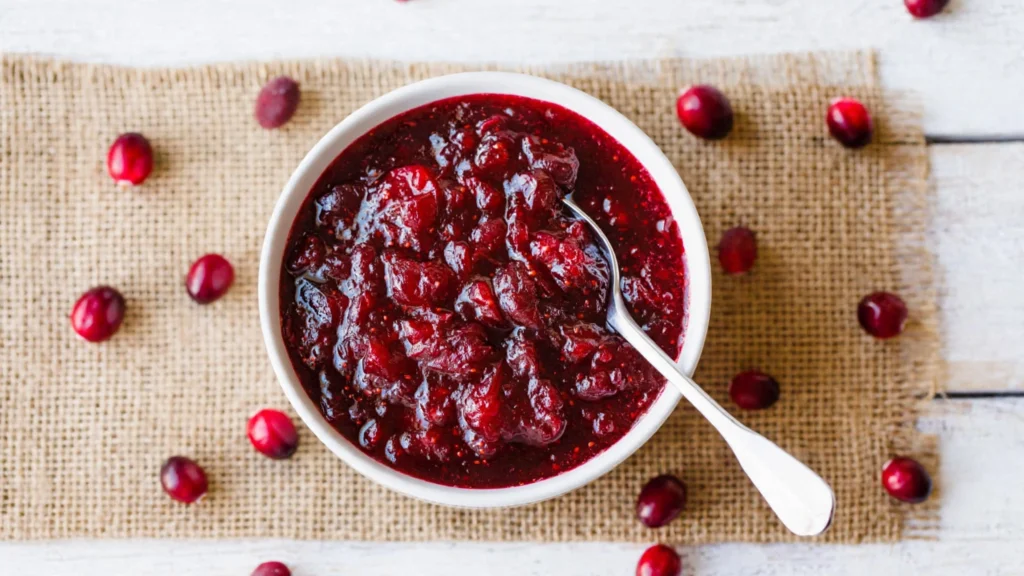

Cranberry sauce is a sweet-tart condiment made by simmering fresh cranberries with sugar and water until the berries burst and release their natural pectin, thickening the mixture into a soft, spoonable sauce. It has a glossy, jammy texture with a mix of whole and lightly broken-down berries, and a flavor that leans tart up front with just enough sweetness to round it out — closer to a bright fruit compote than a heavy, sugary jam.
Why This Recipe Works
- Pectin does the thickening. Cranberries are naturally high in pectin (the same substance that sets jam), so the sauce thickens on its own as it simmers and cools — no cornstarch, gelatin, or added thickener needed.
- Dissolving the sugar first matters. Heating the sugar and water together before adding the berries lets the sugar fully dissolve into a clear syrup, so it coats the cranberries evenly instead of settling and scorching at the bottom of the pot.
- Simmering uncovered removes excess liquid. The lid stays off so steam can escape; this is what turns a thin, watery mixture into a thick, scoopable sauce by the time the berries finish cooking.
Understanding the Ingredients
This recipe uses just three ingredients, and each one plays a specific role:
- Cranberries provide the tartness, color, and the pectin that sets the sauce. Fresh berries give the cleanest flavor, but frozen berries work just as well — the pectin content is unaffected by freezing, so you’ll get the same thickened result.
- Sugar balances the natural tartness and also helps preserve the sauce for longer storage. Because cranberries vary in tartness from batch to batch, treat the amount as a starting point rather than a fixed rule — you taste and adjust after cooking, while the sauce is still warm.
- Water is simply the cooking medium that lets the sugar dissolve and gives the berries room to soften and burst without scorching.
What to Expect While Cooking
The sauce will look surprisingly thin and watery while it’s still bubbling on the stove — that’s normal, not a sign something has gone wrong. The real thickening happens as it cools, once the released pectin has a chance to set. Judge doneness by watching the berries themselves: once most have visibly burst and the liquid around them looks glossy rather than watery, it’s done. Continuing to cook past this point in an attempt to “thicken it in the pot” is one of the few ways this simple recipe can go wrong, since it can leave the cooled sauce gummy instead of tender.
Serving and Make-Ahead
Cranberry sauce is traditionally served cold or at room temperature alongside roasted meats like turkey, ham, or pork, but it’s also good spooned over toast, swirled into yogurt, or layered into a sandwich. It keeps well in the refrigerator for up to a week, so it’s a convenient dish to prepare a few days ahead of a holiday meal — the flavor actually rounds out and mellows slightly after a day or two.
Classic Homemade Cranberry Sauce
Description
A simple three-ingredient cranberry sauce made by simmering fresh cranberries with sugar and water until thick and glossy. Tart, lightly sweet, and ready in about 20 minutes of cooking — perfect for a holiday table or an everyday meal.
Ingredients
Instructions
-
Rinse the cranberries. Rinse them in a colander under cool water. As you go, discard any that are moldy, decayed, very soft, or visibly damaged — good berries are firm and plump (some color variation between berries is normal and not a sign of spoilage).
-
Dissolve the sugar. In a medium saucepan over medium heat, stir the sugar and water together until the sugar fully dissolves and the liquid turns clear, about 2–3 minutes.
-
Cook the cranberries. Add the cranberries and bring the mixture back up to a boil (100°C/212°F). Turn the heat down to low so it drops to a gentle simmer (85–96°C/185–205°F) and cook uncovered for 12–15 minutes, stirring every few minutes. It's done when most of the berries have popped open and the liquid looks glossy, not watery — this visual cue matters more than hitting an exact temperature.
-
Taste and adjust while still warm. Take the pot off the heat. If you'd like it less tart, stir in a little more sweetener now, while it's still warm enough to dissolve easily — don't wait until it's fully cooled.
-
Cool completely. Let the sauce cool to room temperature, about 1 hour — it will visibly thicken as it sits and can then be covered and refrigerated.
Nutrition Facts
Servings 8
- Amount Per Serving
- Calories 116kcal
- % Daily Value *
- Total Fat 0.1g1%
- Sodium 0.5mg1%
- Total Carbohydrate 30g10%
- Dietary Fiber 2g8%
- Sugars 27g
- Protein 0.2g1%
* Percent Daily Values are based on a 2,000 calorie diet. Your daily value may be higher or lower depending on your calorie needs.
Note
Ratio: This recipe uses 12 oz cranberries, 1 cup sugar, and ¾ cup water, which gives a thicker, more tart-forward sauce than versions made with a full cup of water.
Storage: Cool completely, then refrigerate in an airtight container at 40°F/4°C or below for up to 1 week.
Freezing: Freezes well for up to 3 months in a freezer-safe, airtight container. Thaw overnight in the refrigerator before serving.
Reheating: Not needed — the sauce is meant to be served cold or at room temperature. If you'd rather serve it warm, reheat gently in a small saucepan over low heat, stirring now and then.
Pro Tips:
- Sort the cranberries before cooking — a few soft or bruised berries can throw off the flavor of the whole batch.
- Keep the pot uncovered while simmering so the liquid can reduce and the sauce can actually thicken.
- Judge doneness by the berries bursting, not by how thick the sauce looks in the hot pot — it thickens much more as it cools.
Common Mistakes:
- Overcooking to try to thicken the sauce while it's still hot, which can make it gummy once cooled.
- Waiting until the sauce is fully cooled to add more sugar — it won't dissolve well at that point. Adjust sweetness while the sauce is still warm, or gently rewarm it if you need to fix it later.