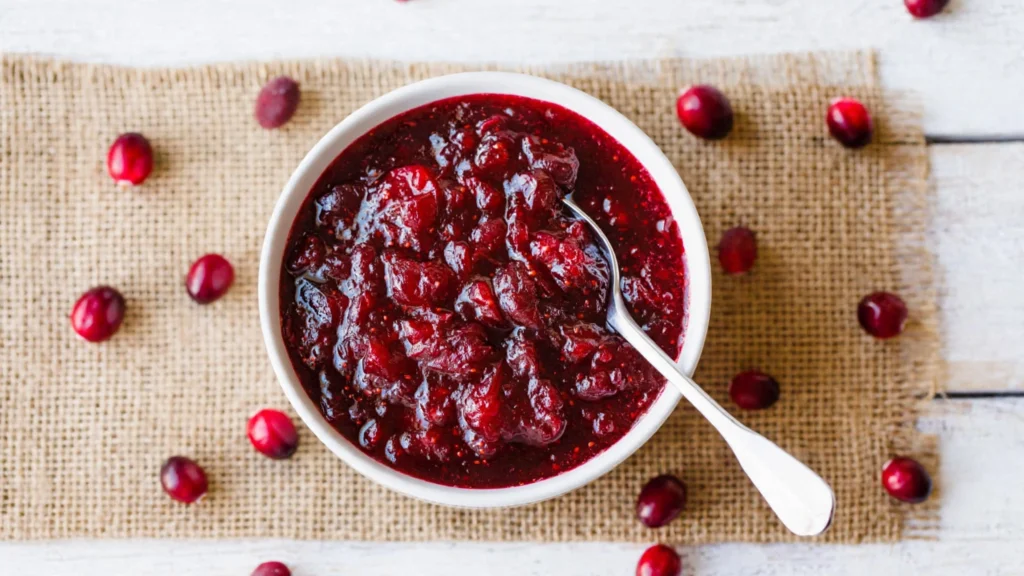
Cranberry sauce is a sweet-tart condiment made by simmering fresh cranberries with sugar and water until the berries burst and release their natural pectin, thickening the mixture into a soft, spoonable sauce. It has a glossy, jammy texture with a mix of whole and lightly broken-down berries, and a flavor that leans tart up front with just enough sweetness to round it out — closer to a bright fruit compote than a heavy, sugary jam.
Why This Recipe Works
- Pectin does the thickening. Cranberries are naturally high in pectin (the same substance that sets jam), so the sauce thickens on its own as it simmers and cools — no cornstarch, gelatin, or added thickener needed.
- Dissolving the sugar first matters. Heating the sugar and water together before adding the berries lets the sugar fully dissolve into a clear syrup, so it coats the cranberries evenly instead of settling and scorching at the bottom of the pot.
- Simmering uncovered removes excess liquid. The lid stays off so steam can escape; this is what turns a thin, watery mixture into a thick, scoopable sauce by the time the berries finish cooking.
Understanding the Ingredients
This recipe uses just three ingredients, and each one plays a specific role:
- Cranberries provide the tartness, color, and the pectin that sets the sauce. Fresh berries give the cleanest flavor, but frozen berries work just as well — the pectin content is unaffected by freezing, so you'll get the same thickened result.
- Sugar balances the natural tartness and also helps preserve the sauce for longer storage. Because cranberries vary in tartness from batch to batch, treat the amount as a starting point rather than a fixed rule — you taste and adjust after cooking, while the sauce is still warm.
- Water is simply the cooking medium that lets the sugar dissolve and gives the berries room to soften and burst without scorching.
What to Expect While Cooking
The sauce will look surprisingly thin and watery while it's still bubbling on the stove — that's normal, not a sign something has gone wrong. The real thickening happens as it cools, once the released pectin has a chance to set. Judge doneness by watching the berries themselves: once most have visibly burst and the liquid around them looks glossy rather than watery, it's done. Continuing to cook past this point in an attempt to "thicken it in the pot" is one of the few ways this simple recipe can go wrong, since it can leave the cooled sauce gummy instead of tender.
Serving and Make-Ahead
Cranberry sauce is traditionally served cold or at room temperature alongside roasted meats like turkey, ham, or pork, but it's also good spooned over toast, swirled into yogurt, or layered into a sandwich. It keeps well in the refrigerator for up to a week, so it's a convenient dish to prepare a few days ahead of a holiday meal — the flavor actually rounds out and mellows slightly after a day or two.